
Learn about Portugal’s subscription to the ESA Ministerial
ESA Member States approve a record contribution of €22.3 billion for 2026-2030 at the Ministerial Council in Bremen. Portugal secures a subscription of €204.8 million, representing a 51% increase compared to 2022.
Portugal will contribute €204.8 million to the European Space Agency’s (ESA) record budget of €22.3 billion for 2026-2030, as agreed at the 2025 Ministerial Council (CM25) held last week in Bremen. The total amount represents approximately 99% of the budget proposed by the ESA Director General and exceeds the €16.9 billion set for 2022.
The Portuguese subscription follows a growth trajectory that began at recent ministerial meetings: from around €73 million in 2016 to €102 million in 2019 and €115 million in 2022. With the current €204.8 million, Portugal secures its largest-ever contribution to ESA, representing a 51% increase in real terms, given the economic conditions of 2025.
“This decision reinforces ESA’s role as a central instrument for capacity building and development of the space sector in Portugal,” says Ricardo Conde, President of the Portuguese Space Agency. “The goal is to transform this subscription into concrete opportunities: more contracts for companies and research centres, more participation in European consortia, and more space for qualified young people who want to work on large-scale space projects.” The President of the Portuguese Space Agency emphasises that this is “the greatest reinforcement ever in Portugal’s participation in ESA and it is taking place in the year that marks the 25th anniversary of Portugal joining the organisation, underlining the country’s commitment to the future of space in Europe”.
The subscription is based on the principle of concentrating investment in areas where the national ecosystem already has skills and capabilities in place and growth potential, with a focus on creating value and economic impact. It is organised around four strategic axes: enhancing the Atlantic positioning, with emphasis on the Santa Maria Space Hub, the Santa Maria Space Technology Centre and Teleport, as well as participation in the European Resilience from Space (ERS) programme, broadening the development of national space solutions and services, particularly in the Atlantic Constellation; industrialisation and new services, including critical technologies, cooperative constellations, and new developments in launch systems through the European Launcher Challenge (ELC) programme; pioneering work with the first mission, conducted from Portugal, for the in-orbit demonstration of autonomous space traffic systems, technological innovation in areas such as high-altitude platforms, propulsion, communications, and space traffic management; and science and knowledge, strengthening national space research in areas such as space medicine, analogue missions, space exploration, astrobiology, biobanks, and instrumentation for astronomy.
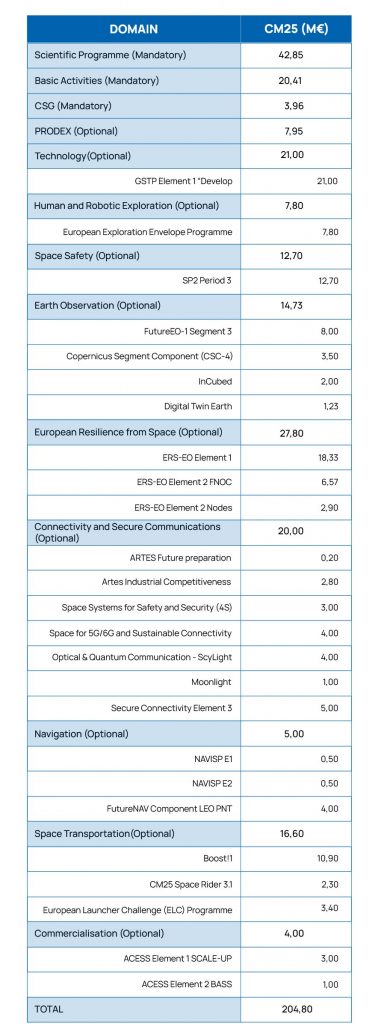
Figures in millions of euros, 2025 ec / cec
The national subscription was based on a consultation process with the space ecosystem, conducted by the Portuguese Space Agency together with companies, universities, and research centres across the country, and submitted as a working basis for discussion by the Space Interministerial Working Group, created in 2025, which brings together the areas of Science and Innovation, Economy, Defence, Infrastructure, and Environment, as well as the Regional Government of the Azores, whose final proposal was submitted to the Government for approval.
In this context, Portugal’s subscription to ESA represents a joint effort by several government agencies. Of the total €204.8 million, 56.7% is secured by the area of Science and Innovation, 16.2% by Defence, 14.1% by Economy, 9.8% by Infrastructure, 1.7% by Environment, and 1.5% by the Regional Government of the Azores, highlighting the across-the-board nature of space policy and the coordination between different areas of government.
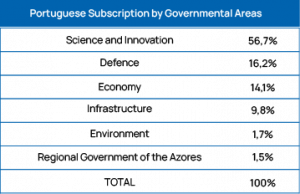
Source: Ministry of Education, Science and Innovation
The contribution from the Regional Government of the Azores will be used to develop regional capabilities, in particular to contribute to the Santa Maria Space Hub, including the Space Technology Centre and the infrastructure associated with the return point for the European reusable vehicle, Space Rider. At the ESA Ministerial Council, a cooperation agreement was also signed between ESA and Portugal for the landing of Space Rider in Santa Maria, with an investment of €15 million expected in this infrastructure, which will serve as the foundation for the operationalisation of future return and access-to-space missions.
From science to security: ESA’s new mandate
During the ministerial meeting, senior representatives from ESA’s 23 Member States, Associated States, and Cooperating States confirmed their support for science, exploration, and technology programmes, as well as a significant increase in the budget for ESA application programmes – Earth observation, navigation, and telecommunications – which will now have a stronger role as pillars of the European Resilience from Space (ERS) initiative, Europe’s joint response to critical security and resilience needs. “This is a major achievement for Europe and a very important moment for our autonomy and leadership in terms of science and innovation,” said ESA’s Director General Josef Aschbacher, highlighting that the now-approved package represents “a 32% increase in contributions, or 17% in real terms, compared to the 2022 Ministerial Council.”
According to ESA, this Ministerial Council also marks the first step in implementing the 2040 Strategy, setting the course for European ambitions in space and the framework for the Agency’s new mandate for the coming decades. In the year marking its 50th anniversary, ESA is reinforcing its focus on European autonomy, technological independence, guaranteed access to space, and the ability to respond to global challenges such as climate, security, critical infrastructure resilience, and deep space exploration.
