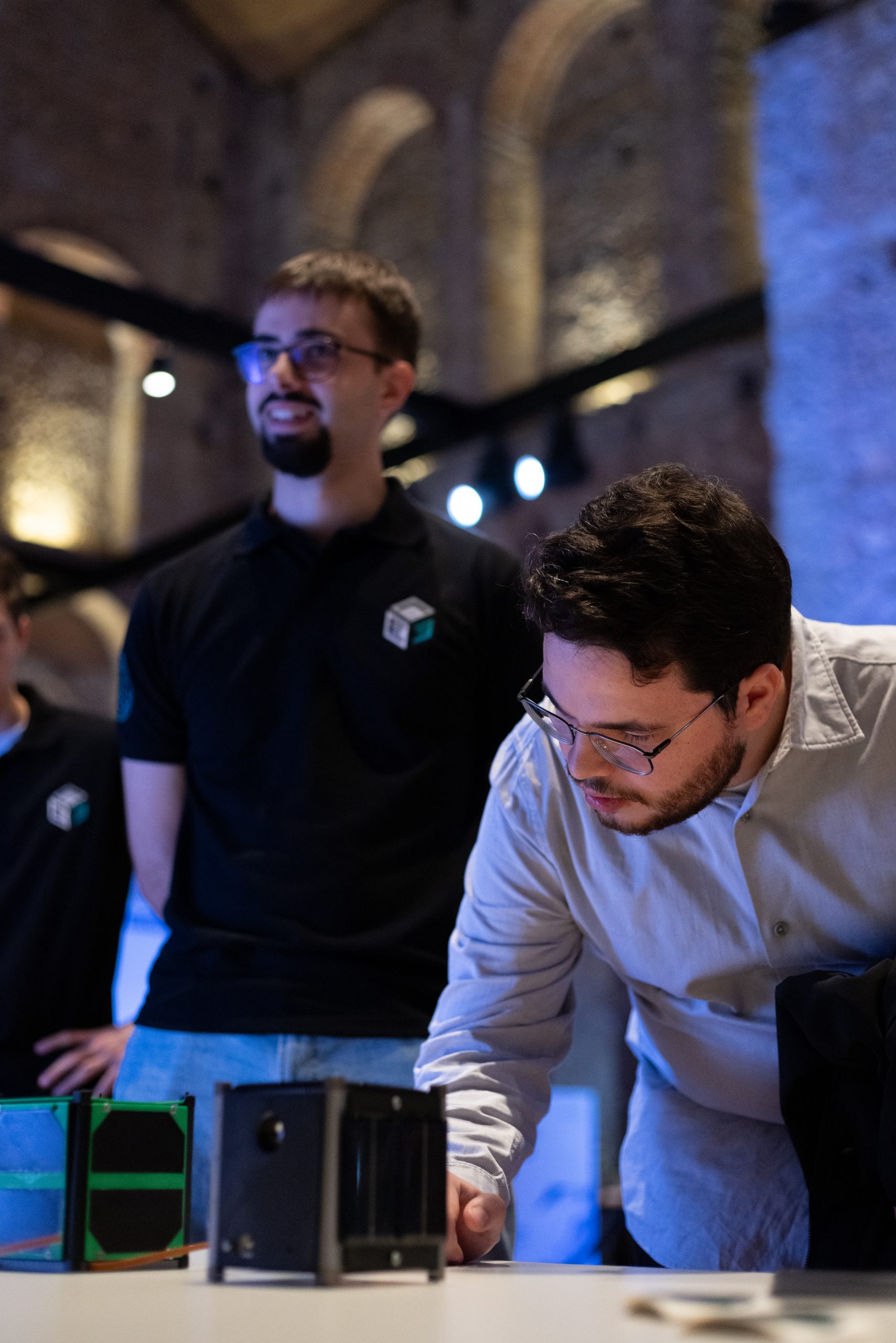
University nanosatellites compete for a ride into space
The Portuguese Space Agency has challenged university students to build a satellite from start to finish, with the promise that the best one could be launched into space. Four teams reached the final stage of CubeSat Portugal and presented the satellites they had built.
At student parties, brewer’s yeast usually ends up in a pint glass, but at the University of Minho’s School of Engineering, a group of students wants to send it into space. With support from the Life and Health Sciences Research Institute (ICVS), the team genetically modified the yeast to react to radiation and put it on board Aurora, one of four CubeSats handed over to the Portuguese Space Agency at the CubeSat Portugal: From Idea to Satellite showcase, held in Lisbon on 14 November.
Following Astronaut for a Day and the European Rocketry Challenge, CubeSat Portugal was the competition the Agency launched in 2024 to get higher-education students building a satellite from start to finish. The format chosen was the CubeSat, a 10x10x10 cm (1U) nanosatellite that fits in the palm of your hand. Created in the late 1990s by two American universities, the format was designed to cut the cost and complexity of a satellite and give students experience of every stage of a space mission.
The Agency will now assess the four finalist satellites with support from FOSSA Systems and, at the end of the first quarter of 2027, announce which will be launched.
Ricardo Conde, President of the Portuguese Space Agency, explained in his opening address that CubeSat Portugal was born of the ambition to make Portugal a spacefaring nation: ‘We needed satellites flying, people to build them, people to launch them, rockets and critical mass. With EuRoC, we were already training those who launch and showing that we could run a highly complex competition, but one link was missing: integration. Inspired by CanSat, we wanted to turn that idea into a purpose.’
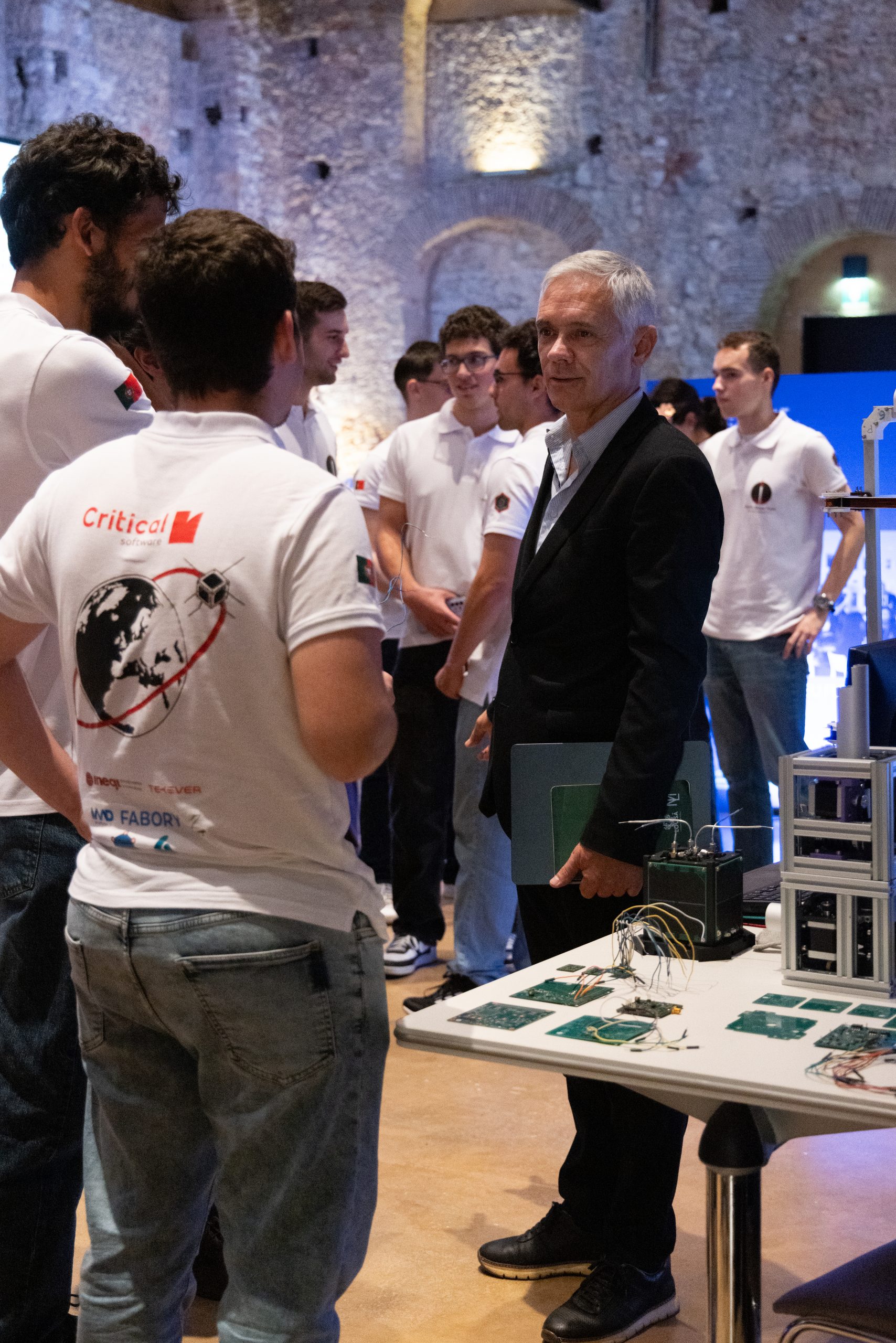
Just hours before Ricardo Conde opened the session, the Porto Space Team members were still working on ICARUS. Two years ago, the team from the Faculty of Engineering of the University of Porto decided to do almost everything in-house. It bought the power supply and the solar cells. The first on-board computer board came back with its pins mixed up, and one team member spent seven hours soldering 150 capacitors, which looked for all the world like ‘spaghetti’. The result is a nanosatellite built to measure the electron density of the ionosphere, the layer of the atmosphere that interferes with GPS signals.
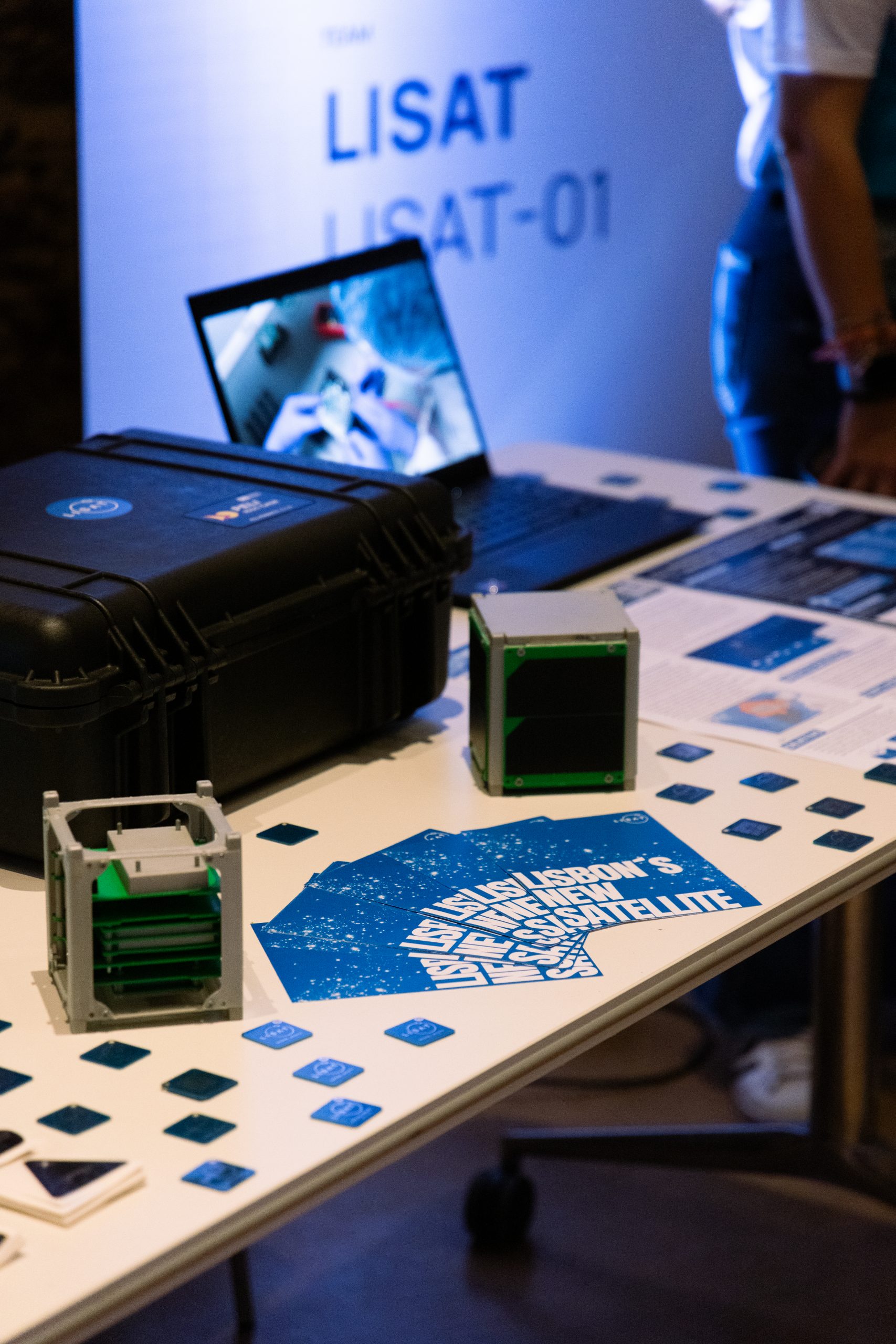
While ICARUS looks up at the ionosphere, LISAT-01 turns its gaze to the sea. The satellite built by the Instituto Superior Técnico team grew out of a challenge from the Portuguese Navy. In a country with one of Europe’s largest exclusive economic zones, the team set out to launch a satellite that listens to ships. In orbit, it will pick up the signals each vessel uses to announce itself, relay them to ground stations on the mainland, in Madeira and in the Azores and, finally, make them available in a public database.
Listening from space to signals sent from Earth is also FOSSA Systems’ business. The company uses satellites to provide connectivity in remote places and is the Portuguese Space Agency’s partner in assessing the CubeSat Portugal finalists. Now with offices in Madrid and Lisbon, it began as a project by Julián Fernández, who at 16 created Spain’s first picosatellite. That was the story Mário Rodrigues, FOSSA’s Strategic Programmes Manager, told the students at the Thalia, before telling them what employers look for: ‘Reading CVs with good grades is one thing; finding people with the passion we’ve seen here is quite another.’
The CVs of the Espaço ao Cubo students carry a line few undergraduates can claim: they founded an association so that they could build a satellite. Coming from different institutions, they needed a vehicle that would allow them to enter. That is how the association came about. Through school workshops, they paid for the first model of the nanosatellite. The result is TejoOne, a satellite that hunts for space debris around 3 cm across, which current systems struggle to detect, using the same camera it relies on to get its bearings from the stars. The team wants to make public the debris it finds and pave the way for constellations dedicated to monitoring space junk. Espaço ao Cubo now brings together 41 people from eight institutions and 14 degree courses, including law and design: proof that there really is ‘space in space for everyone’.
If Espaço ao Cubo funded itself through workshops, the Minho-based MAST team went knocking on a brewer’s door, though this time not to sponsor a student party. Aurora’s yeast comes straight from Super Bock’s vats, and the University of Minho team had to win over a table of the group’s executives, who ended up investing €10,000 in the project.
Each team found its own backers. Critical Software is Porto Space Team’s main sponsor; MEO backs LISAT and Vyoma, a German company that tracks objects in orbit, is supporting Espaço ao Cubo. The Agency did the rest of the work of bringing academia and industry together. Over two years, it organised workshops to support the teams and brought on board partners such as the Atlantic Space Consortium (ASC), ANACOM, GMV, LusoSpace, Indra, ISQ, ESA/ESA Academy, Thales, IST NanoSat Lab and D-Orbit. Ricardo Conde acknowledges that this was one of the competition’s aims, and he wants to go further: ‘Some people told me they were thinking of starting a company from their team. If we want to measure the success of this competition, that’s the way to go: by creating new companies, with capable people.’
Before the morning was out, Pedro Coimbra, Education Programme Manager at the Portuguese Space Agency, brought the team leaders together for a round table and asked them what had cost them most. One had put their degree on hold to devote themselves to the team. Another only realised how much the project mattered when they noticed they were missing more lectures than they attended. Others cried and cheered when the final review was over.
Marta Gonçalves, Education and Science Programme Manager at the Portuguese Space Agency, drew on these stories to close the session. ‘This has a huge impact on your academic and personal lives. It’s a tremendous effort,’ she said, before making a promise: ‘I don’t know whether today you’re nervous about handing over the project you’ve built with such care, or relieved that it’s over. Now, and over the coming months, the ball is in our court, and we promise to give your projects our very best attention.’
The results of CubeSat Portugal will be announced at the end of the first quarter of next year.e